Blue Cave from Split vs Hvar: A Captain's Honest Comparison
Should you visit the Blue Cave from Split or from Hvar? A captain breaks down the trade-offs — boat hours, weather risk and which base wins for which traveller.
If you have spent any time researching the Blue Cave, you have run into the same question every traveller eventually asks:
Do I see the Blue Cave from Split, or do I see it from Hvar?
The marketing on both ends pushes its own answer, of course. Split operators will tell you Split is the place. Hvar operators will tell you Hvar is closer. Both are technically right and neither is fully honest, because the answer genuinely depends on the rest of your trip.
I run boat tours out of Split, so I have a bias — and I will be direct about it later in this piece. But the geography is the geography, and the right answer here is not the same for every traveller. Here is the honest comparison.
TL;DR
| Factor | From Split | From Hvar |
|---|---|---|
| Distance to Biševo | ~50 nautical miles | ~18 nautical miles |
| One-way boat time | ~90 min | ~40 min |
| Typical day length | 9–10 hours | 4–6 hours |
| Departure time | 07:00 | 08:30–09:30 |
| Weather cancellation rate (rough) | ~12–15% (season-wide) | ~8–12% (season-wide) |
| Other stops on the route | 3–5 (often Stiniva, Pakleni, Hvar Town) | 1–3 (often Stiniva, Budikovac) |
| Approx. private tour cost | €900–€1,100 boat | €700–€900 boat |
| Best for | Travellers already based in Split | Travellers already based in Hvar |
The geography that drives everything
The Blue Cave is on Biševo, a small island just south of Vis. Vis itself is the outermost inhabited island in central Dalmatia, about 30 nautical miles offshore from Split. Biševo sits a further few miles south.
From Hvar Town, you cut almost diagonally across to Vis and Biševo. From Split, you go around the southern tip of Brač, then south to Vis. It is more than twice the distance.
That single fact — that Hvar is roughly half as far from the cave as Split is — explains everything that follows. Boat hours, weather risk, day length, and what you can fit in around the cave are all downstream consequences of where you start.
What the day actually looks like
A Blue Cave day from Split
You arrive at the meeting point in Split at 06:45 for a 07:00 departure. The day is long, so we start before the city is awake. The first 45 minutes are a steady cruise along the south coast of Brač — pretty, but you are still waking up.
You arrive at Biševo around 09:00. If the wind is calm, you go straight to the cave. If there is a queue (peak July, August), it can take 30–45 minutes before you are inside. The cave itself is roughly 15 minutes — a small dinghy takes you in, you sit in stunned silence, you come out.
From there a Split-based tour typically does one or more of:
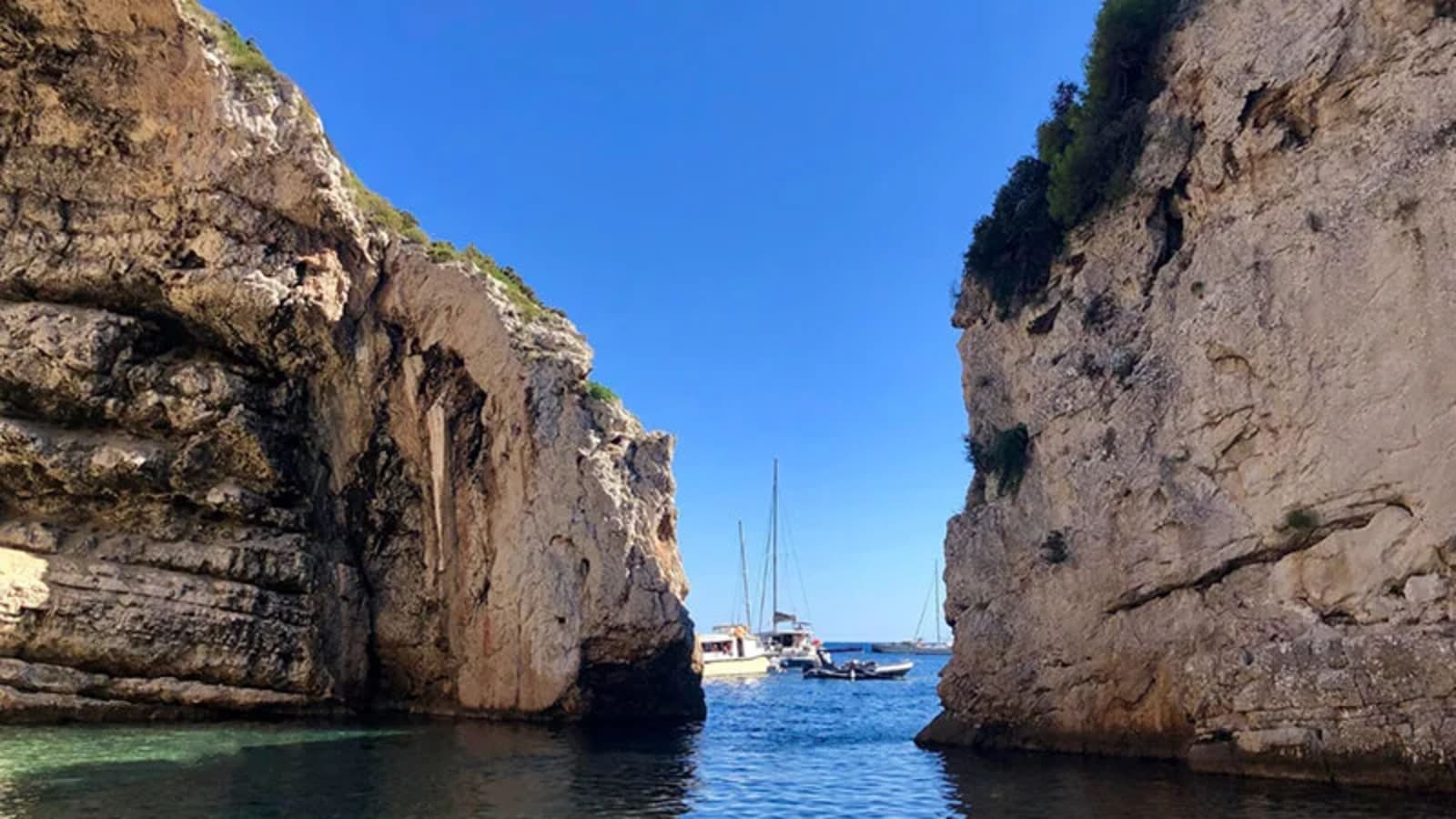
- Stiniva Bay on Vis — a hidden beach enclosed by cliffs, voted one of the most beautiful in Europe.
- Budikovac (Blue Lagoon) — a shallow turquoise bay on the way back.
- Pakleni Islands — for a swim and lunch.
- Hvar Town — a 60–90 minute stop before the run back to Split.
You are back in Split around 17:30–18:30. The total day is 10–11 hours, of which roughly 4.5–5 hours are actually on the boat.
A Blue Cave day from Hvar
You leave Hvar at 08:30 or 09:30, depending on the operator. About 40 minutes later you are at Biševo. Same cave, same dinghies, same 15 minutes inside.
After the cave, a Hvar-based tour typically does:
- Stiniva Bay on Vis.
- Komiža — the small fishing town on the west side of Vis. Some operators stop for lunch there.
- Budikovac (Blue Lagoon) — sometimes, depending on wind direction.
You are usually back in Hvar by mid-afternoon. The total day is 4–6 hours, of which roughly 2 hours are on the boat.
The two days are visiting the same cave. They are not the same day.
What you give up by going from Split
The honest version: time on the boat that does not produce a memory.
A 10-hour day at sea is a lot, especially in mid-July when the air temperature is 33°C and the sun is unforgiving. Most guests handle it fine. Some find the sustained boat time wearing — particularly families with young children, or anyone who is prone to seasickness in any kind of swell.
The transit between Split and Vis takes you across the open channel west of Brač. In the morning, it is usually calm. By 14:00–15:00, the maestral (the regional north-westerly afternoon wind) often builds. We time our return run to be inside that window, but on rougher days the return is bumpier than the outbound.
You also commit your entire day to one main attraction. If the cave is closed for wind that morning, the day pivots to a “best alternative” — which we plan for, and which is still good, but is not why you booked.
What you give up by going from Hvar
Mainly: the rest of the day.
A 4–6 hour Blue Cave trip from Hvar finishes by 14:00 or 15:00. That is fine if you are spending the whole evening in Hvar Town. It is a poor use of money if the Blue Cave trip is your only day on the boat and you wanted to also see the Pakleni Islands, Šolta, or Trogir.
The Hvar-based Blue Cave trip is a focused, efficient experience. The Split-based version is a fuller “best of central Dalmatia in one day” experience. Different products.
The other thing you give up by going from Hvar: the logistical overhead of being in Hvar in the first place. If your Croatia trip is built around Split, taking the catamaran to Hvar just to run a Blue Cave tour usually does not pencil out.
Weather cancellation: the part nobody publishes
Both versions get cancelled when the cave itself is closed — which happens when there is south-easterly wind (jugo) strong enough to make the cave entrance unsafe for the small dinghies. This affects both bases equally; if the cave is closed, it is closed regardless of where you started.
Where the two versions differ is in the transit-related cancellations. We sometimes cancel a Split-based Blue Cave day not because the cave is closed, but because the open channel between Brač and Vis is too rough for a comfortable 90-minute crossing. From Hvar, that 40-minute crossing is shorter, more sheltered, and less likely to be the deciding factor.
In rough numbers across the May–October season:
- From Split: about 12–15% of scheduled Blue Cave days end up cancelled or re-routed.
- From Hvar: about 8–12%.
The difference is not enormous. In shoulder months (May, June, late September) the gap widens. In peak summer (July, August) both numbers drop closer together because the weather is stabler.
If your trip has flexibility — multiple possible days for the Blue Cave — book early in your stay so a reschedule has somewhere to go. This matters more than the choice of base.
The cost honestly
Comparing private-tour prices, ballpark:
- Blue Cave from Split (full-day private boat, ~10 hours, up to 12 guests): €900–€1,100 per boat.
- Blue Cave from Hvar (half-day private boat, ~4–6 hours, up to 12 guests): €700–€900 per boat.
Per-person, with 4 guests, that is roughly €230 vs €180. With 8 guests, roughly €115 vs €90.
But — and this is the part the marketing pages skip — if you are doing a Hvar-based Blue Cave trip and you are not already staying in Hvar, you also need to add:
- Catamaran or ferry to Hvar (around €11–€20 per person, each way).
- A night’s accommodation in Hvar in summer (often €150–€300 in mid-tier hotels and apartments).
- The half-day in Hvar you have effectively committed to (lunch, dinner, etc.).
When you add that up, the apparent saving on the boat disappears. From-Hvar is almost always cheaper only if you were already going to be in Hvar anyway.
So which one should you book?
Cutting through everything above, the decision tree I would actually use:
- You are already staying (or already going to stay) in Hvar. Do the Blue Cave from Hvar. Shorter day, less boat time, you get back to Hvar in time for a proper evening. This is the right call for almost everyone on this path.
- You are basing your Croatia trip in Split and Hvar is not on your itinerary. Do the Blue Cave from Split. Specifically, book a full-day tour that includes Stiniva, the Pakleni Islands, and a Hvar Town stop so the boat hours are paying you back. This is what we run as our Blue Cave & 5 Islands tour from Split.
- You are in Split but considering an overnight in Hvar specifically to do the Blue Cave. Honestly, do not do this for the Blue Cave alone. The savings on the boat are eaten by the cost of getting to and staying in Hvar. Either commit to spending two nights in Hvar (so there’s more reason to be there) or do the full-day Blue Cave tour from Split.
- You are prone to seasickness, or travelling with young children or older relatives. Go from Hvar if at all possible. The 40-minute crossing vs the 90-minute crossing is genuinely a different experience.
- You only have one day in Split and want the Blue Cave to be part of it. Do it from Split, accept the long day, and budget some real recovery time the next morning.
My bias, honestly
I run tours out of Split, so I make my living when people pick the Split version. That said: when guests email me describing an itinerary that has them staying in Hvar already, I tell them to do the Blue Cave from Hvar. It is the right call for them and they have a better day. The point of writing this is not to redirect every reader to our Split boats — it is to help you book the right product, even if the right product is not ours.
If you are still unsure after reading this and you want a captain’s opinion on your specific itinerary, write to us. Send dates, the rough plan for the rest of your Croatia trip, and the number of guests. We will give you the honest take — including a recommendation to skip the Blue Cave entirely if your dates fall in a weather window where it is likely to be cancelled.
For most of our guests, the answer is the Blue Cave & 5 Islands tour from Split — because most of our guests are already in Split and would otherwise have to disrupt their plans to get to Hvar. But it depends. It almost always depends.
For broader context on how the Blue Cave tour stacks up against the other tours we run from Split, see Best boat trips from Split: a captain’s ranking. And if you are leaning toward the Hvar route already, the Hvar boat tour from Split guide covers the day-trip alternative — going to Hvar and back in a single day rather than basing there.
Frequently asked questions
Is the Blue Cave closer to Split or Hvar? +
Hvar is significantly closer. From Hvar Town the Blue Cave on Biševo is about 18 nautical miles (~33 km), roughly 40 minutes on a fast boat. From Split it is about 50 nautical miles (~93 km), roughly 90 minutes on a fast boat. That distance is the single biggest reason to prefer one base over the other.
Is the Blue Cave the same experience from Split or Hvar? +
The cave itself is identical — the same 15-minute visit, the same blue light, the same small dinghies that take you inside. What differs is everything around it: how long you are on the boat, what other stops are on the route, and how likely the trip is to be cancelled for wind.
Which is better value: Blue Cave from Split or from Hvar? +
It depends on where you are already staying. If you are in Split, a direct Blue Cave tour from Split is the right call — the same day costs less than relocating to Hvar for a single trip. If you are already staying in Hvar, taking the Blue Cave tour from there is more efficient and usually cheaper than a Split-based equivalent.
Can I do the Blue Cave from Split without spending all day on the boat? +
Not really. A direct Blue Cave tour from Split is a 10-hour day with significant time at sea. If you want the cave without the long day, your best option is to base yourself in Hvar for at least one night and run a shorter trip from there. Otherwise, choose a tour from Split that builds in good swim stops on the way back so the cruising time earns its keep.
Does the Blue Cave get cancelled more often from one base than the other? +
Yes — slightly. Tours from Hvar have a marginally lower cancellation rate because the boat spends less time in the channel between Brač and the open Adriatic, where afternoon winds (the maestral) build first. In practice the difference is small: maybe 3–5 percentage points across the season. The bigger factor is the time of year, not the departure point.
